
For more than a decade, API management has been a fundamental part of backend architecture. API Managers have helped organizations centralize APIs, control access, enforce policies, manage traffic, and connect applications to the services they need.
But the interaction model is changing.
AI Systems do not behave like traditional applications. An AI Agent can decide which tool to use, execute multiple operations to complete a task, incorporate new context, and change its next actions based on the results.
In response, API management vendors are adding AI capabilities to platforms that were originally designed for a different type of interaction. What used to be an API Gateway is now an AI Gateway. In many cases, what was already there is still there, just with "AI" added to the name.
And that raises an important question for technology teams:
Are we actually preparing our backend for AI Systems, or are we simply adding AI capabilities to an architecture that was never designed for them?
When AI Systems Start Changing the Rules
Traditional API Managers are built around familiar concepts: APIs, consumers, applications, requests, policies, and services.
AI Systems introduce new units of interaction: agents, MCP tools, context, tokens, budgets, and chains of actions.
When these two worlds meet, problems emerge that cannot always be solved by simply adding another feature, another plugin, or, at worst, putting the "AI" prefix in front of an existing product.
At best, we add another layer to adapt the traditional service.
But eventually, the seams start to show.
And when those seams are everywhere, they become difficult to ignore.
1. Requests No Longer Tell the Whole Story
Traditional rate limiting is usually based on the number of requests. But for an AI System, a request does not necessarily represent a fixed amount of work.
One call may consume a handful of tokens. Another may require a much larger context. An agent may also generate dozens of calls to complete a single task.
That means controlling only the number of requests may no longer be enough.
AI Systems need mechanisms that can account for tokens, context, inference consumption, and budgets, not just traffic.
The question is no longer: How many requests can this consumer make?
It becomes: How many resources can this AI System use to complete a task?
That may sound like a small change, but it directly affects how the backend needs to be governed.
2. A Single Principal No Longer Represents Who Is Acting
In a traditional architecture, the identity model is relatively straightforward:
User → Application → API
With AI Systems, the chain can look more like:
User → AI Agent → MCP Tool → API → Service → Data
The agent may act on behalf of a user, have permissions of its own, use different tools, and make decisions while a task is being executed.
Authenticating a request, therefore, is no longer enough to understand the full operation.
The system needs to know:
- Who initiated the action
- Which agent is executing it
- On whose behalf it is acting
- Which tool it is using
- What permissions it has
- What data it can access
- What actions it can trigger
Identity is no longer simply a property of the request. It becomes part of the execution context of the AI System.
3. Every Additional Layer Can Increase Latency
API Managers have evolved through policies, extensions, and plugins to address requirements such as authentication, authorization, rate limiting, transformation, observability, logging, and security.
It is a flexible and widely adopted model. But every additional capability can introduce another step into the execution path.
This becomes especially relevant when the consumer is no longer an application making a handful of calls, but an AI Agent that may execute dozens of operations to complete a single task.
A small amount of latency added to every call can multiply quickly.
The problem is not necessarily that a particular plugin is slow.
The problem is that an architecture built as a chain of independent layers may not be the right model for systems that execute dynamic chains of actions.
4. MCP Tools Need Their Own Governance Surface
AI Systems are also changing how applications interact with services.
An agent can dynamically discover and use MCP tools to retrieve information, execute operations, or interact with other systems.
An MCP tool call may look like an API call, but from the system's perspective, it represents something different. It can involve identity, context, permissions, data, budget, and downstream consequences.
Simply treating MCP tools or agent tools as new endpoints, therefore, does not solve the entire problem.
Technology teams need to govern which MCP tools exist, who can use them, which agents can invoke them, under what context, and what those tools are allowed to do.
That requires a governance surface designed around AI Systems, not simply one designed around APIs.
The Problem Is Not the API Manager. It Is the Backend Model.
Faced with these challenges, the simplest response is to keep adding capabilities:
- A new policy for tokens
- A plugin for agents
- Another extension for MCP
- A new authorization layer
- Another layer for observability
But there is a limit to this approach.
If every new requirement introduced by AI Systems is solved by adding another layer on top of an existing backend, we are adapting an architecture designed for a fundamentally different interaction model.
The problem, therefore, is not simply what features an API Manager offers. It is where and how the system's logic actually runs.
Ultimately, this is a technology problem: a problem with the technology layer that interacts with the machine and determines how the system executes.
AI Systems require a backend that understands agents, MCP tools, context, and dynamic logic as native parts of the system, not as exceptions added later.
The Solution Is Technological
We need technology designed from the ground up for a world in which AI is an intrinsic part of software, from development through continuous evolution and operation.
Software will increasingly be built in natural language. What will continue to matter is the technology underneath it.
Python and Java, for example, were designed for a different world, at a different point in the evolution of software. AI-era software and AI Systems need technology that provides the capabilities this new era requires:
- Technology that does not tie us to endless software dependencies, compiler versions, and constant stack maintenance.
- Technology that allows the stack to become dramatically smaller rather than increasingly complex because we have to combine hundreds of different pieces, each solving a narrow problem, none of them built on an AI-native development technology.
We already have excellent frontend tools and increasingly capable IDEs with powerful AI assistants. They automate more and more of the many steps required to build and deploy our systems.
But underneath all of that, we may still be maintaining thousands of libraries in our codebase, resolving compatibility between versions of the same runtime, and taking systems offline because a security patch needs to be applied.
If we can fundamentally change that, we will be moving in the right direction.
Until then, we are putting the body of a Tesla on top of the engine of a steam locomotive.
Adding an AI layer does not change the engine underneath. An AI-native backend does.
From Adding AI to API Management to Building an AI-Native Backend
Teams are moving off traditional API gateways because AI agents don't behave like applications. They need token and budget accounting, multi-hop identity, and native MCP governance. AVAP is built as an AI-native backend instead of a gateway retrofit.
Instead of adding an AI layer on top of a traditional API management architecture, AVAP provides the technology and runtime in which backend logic is part of the AI System itself.
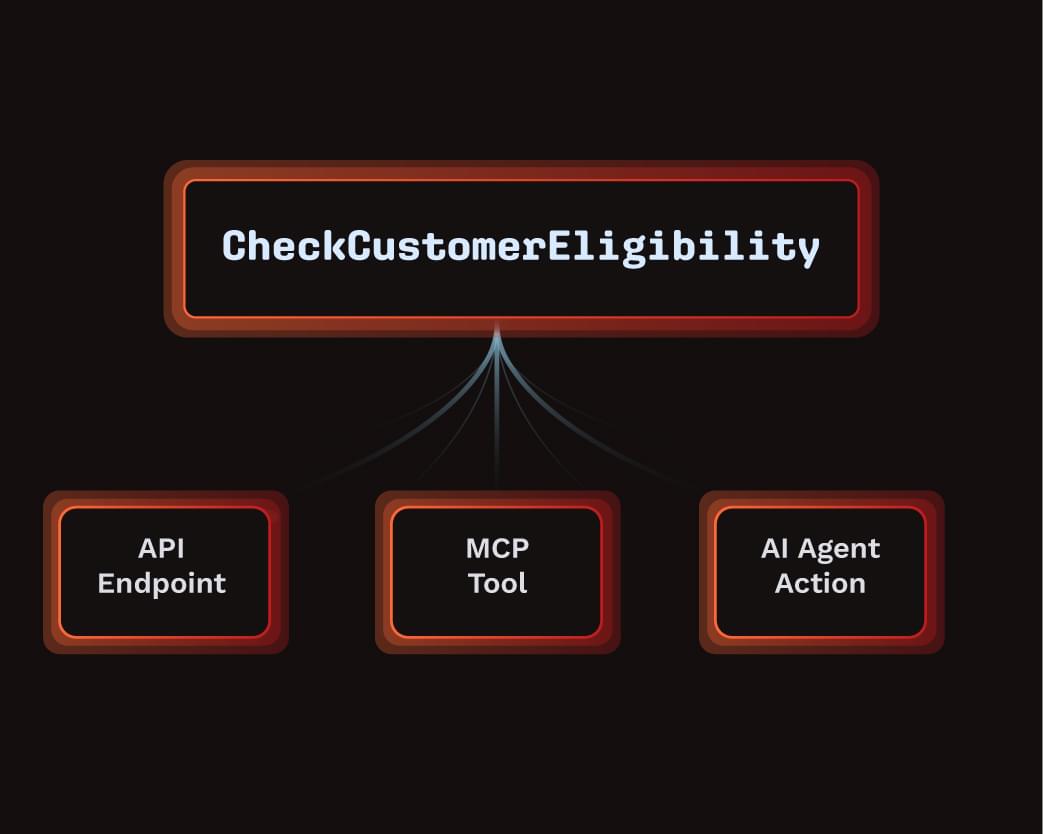
Logic Blocks are AVAP's building blocks for that backend. A single Logic Block can encapsulate business logic once and be exposed simultaneously as an API endpoint, an MCP tool, or an action an AI Agent can invoke, all within the same runtime.
For example, the same CheckCustomerEligibility Logic Block can serve a traditional application through an API, an AI Agent through MCP, and another backend workflow as an internal service, without implementing the business logic three times or maintaining separate execution layers.
This eliminates duplicated logic and the integration steps normally required to connect the same capability across different interfaces, while keeping execution in the same runtime.
Build the logic once. Expose it wherever the AI System needs it.
In a traditional architecture, an agent may have to pass through multiple layers before reaching the logic it needs to execute. In an AI-native backend, that logic is part of the system from the start.
The difference is not simply about having more features. It is about the model.
The backend stops being a collection of services that AI has to connect to and becomes an environment where humans and AI can build, execute, and operate business logic together.
That shift also makes it possible to apply policies and governance closer to the logic they protect and the actions actually being executed.
The Backend Is Changing
The question is no longer how "AI" an API Manager can become. The question is different:
Are we building a backend for the AI era, or adapting a backend designed for another era?
AI Systems need more than APIs, gateways, and new AI layers. They need technology capable of integrating business logic, AI Agents, MCP tools, context, and operations into the system itself.
That is the shift AVAP is introducing: moving from managing interactions between services to building and operating the complete AI System.
Because AI is not simply changing the applications we build. It is changing the technology we build them on.
The next backend is not an AI-enabled API Manager. It is an AI System.
FAQ
Why do traditional API gateways struggle with AI agents and MCP tool calls?
Traditional gateways are built around requests, APIs, consumers, and services. AI Agents introduce dynamic execution, multi-step actions, context, tokens, budgets, and tool calls. These require governance of the entire execution context, not just the individual request.
How should backend teams govern the MCP tools their AI agents use?
MCP tools should be governed as executable capabilities, not simply as API endpoints. Teams need to control which agents can use them, what permissions they have, what data they can access, and what actions they can trigger.
What is an AI-native backend, and how is it different from bolting AI features onto an existing API manager?
An AI-native backend is designed around AI as part of the system's architecture and execution model. Instead of adding AI capabilities around existing APIs, it makes business logic, AI Agents, MCP tools, context, and execution native parts of the backend.
What are Logic Blocks in AVAP?
Logic Blocks are AVAP's building blocks for backend logic. A single Logic Block can be exposed as an API endpoint, an MCP tool, or an AI Agent action within the same runtime, allowing the logic to be built once and reused across different interaction models.
Does an AI-native backend eliminate APIs?
No. APIs remain an important interface for software systems. The difference is that the same underlying business logic can also be exposed as MCP tools, services, or AI Agent actions without requiring separate implementations.
Does this mean organizations need to replace their existing backend?
Not necessarily. Existing APIs and services can continue to operate while organizations introduce AI-native capabilities. The shift is toward making new and evolving backend logic native to AI Systems rather than adding more layers around a traditional architecture.
About Raúl
Raúl is the Founder and CEO of AVAP. He is a serial entrepreneur with 30+ years of experience building technology companies across Silicon Valley, Europe, the US, Africa, and Latin America. He previously founded Pademobile and HalCash, and is the driving force behind AVAP, a new technology for building and operating AI Systems.