
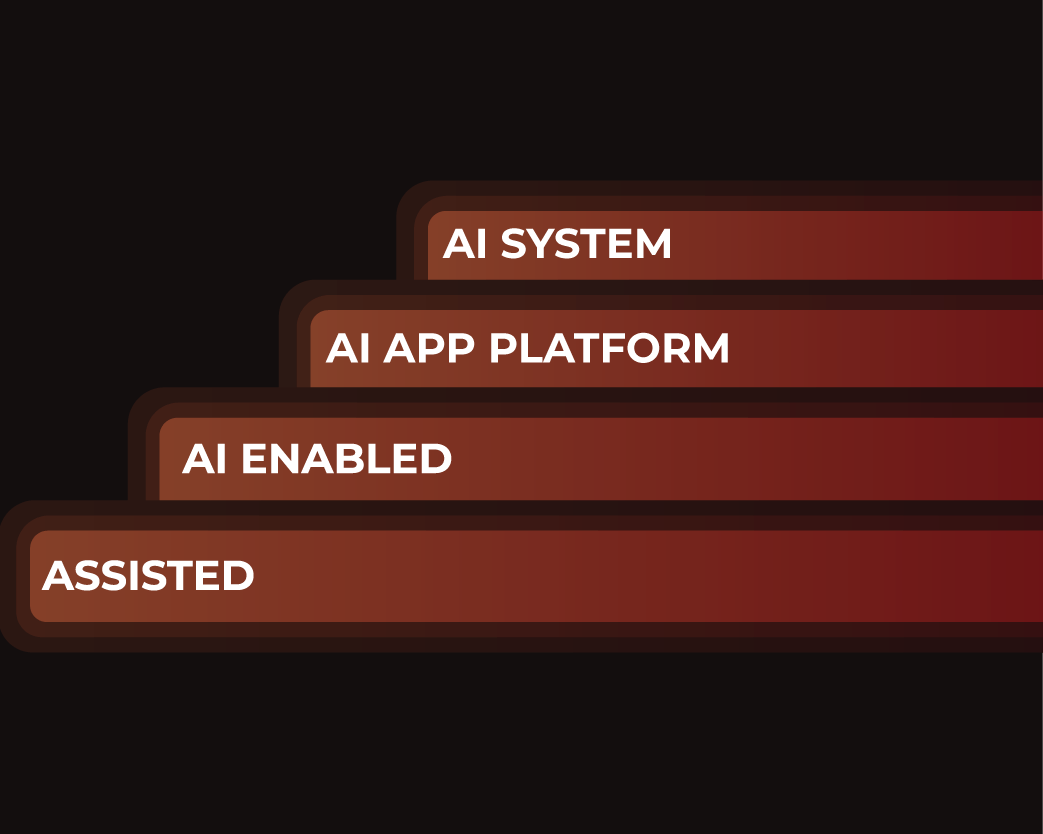
Artificial intelligence is changing the way software is built. But it is also creating a problem of categories.
At AVAP, we use the term AI Systems to describe software backend systems in which business logic, APIs, MCP tools, and AI agents can work together and continuously evolve with the participation of both humans and AI.
That is not the same as an AI-assisted development tool, an AI capability added to a traditional stack, or a platform for building AI applications. And the difference matters when a company is evaluating which technology to use to build its next generation of software.
Four Categories That Are Often Confused
1. AI-Assisted Development Tools: AI Helps Write the Code, the Architecture Stays the Same
These are tools that help developers write software faster. They can generate code, explain functions, suggest changes, detect errors, create tests, or assist developers inside an IDE.
The software itself is still built using the traditional development model:
The developer writes or requests code → The code is modified → Compiled → Tested → Deployed
AI primarily acts as a developer assistant.
Examples include GitHub Copilot, Cursor, and Claude Code.
These tools can improve developer productivity, particularly on coding tasks. In a controlled experiment conducted by GitHub, developers using GitHub Copilot completed a coding task 55% faster than developers who did not use it.
But faster code generation does not necessarily change the underlying architecture or runtime on which the software operates. The development process may become more efficient while the software itself still follows the traditional model of compilation, testing, building, and deployment.
2. AI Added to Traditional Stacks: AI-Enabled, Not AI-Native
A second category consists of existing platforms and technologies that incorporate AI capabilities.
For example, a traditional backend may add:
- A language model
- An AI API
- Vector search
- RAG
- A chatbot
- Agents
- Code-generation capabilities
AI becomes a new capability within the existing stack. The underlying architecture, however, may continue to work exactly as it did before.
Traditional backend + AI capabilities ≠ AI-native backend
This can be a perfectly valid approach for adding AI to existing systems. But it does not mean that the entire platform was designed around continuous interaction between software, data, models, and agents.
3. AI Application Platforms
These platforms are specifically designed to build applications that use AI. They may provide components for:
- Integrating models
- Building agents
- Implementing RAG
- Managing prompts
- Connecting data sources
- Creating workflows
- Deploying AI applications
Their primary goal is to make it easier to build AI applications.
For example, a company might use one of these platforms to build an assistant that searches internal documentation, generates answers, and performs specific actions.
The application uses AI as a central part of its functionality. But that does not necessarily mean that the organization's entire backend is an AI System.
Agent frameworks such as LangChain and CrewAI also fit primarily into this category. They provide tools and abstractions for building AI applications and agents, but they are not, by themselves, a complete AI-native backend.
4. AI Systems: Logic, APIs, Tools, and Agents in One System That Evolves
An AI System starts from a different premise.
An AI System is not simply an application that uses AI. It is a software backend system in which business logic, APIs, data, tools, and AI agents can operate as parts of the same system and continuously evolve.
AI is not simply added to the application. It becomes part of the system's development, execution, and operation lifecycle.
That means an AI System must address more than the creation of an AI application.
It needs to provide an environment to:
- Develop business logic
- Expose and consume APIs
- Create and operate MCP tools
- Integrate AI agents
- Manage the knowledge and context required by the system
- Execute the system
- Deploy it
- Operate it
- Enable humans and AI to continuously participate in its evolution
The fundamental difference is what constitutes the system and where AI lives within it.
The Boundary Between the Four Categories
The simplest way to distinguish these categories is to look at which parts of the software lifecycle actually change.
| Category | AI helps develop the software | AI is part of the application | AI and backend form an integrated system | System can continuously evolve with AI |
|---|---|---|---|---|
| AI-assisted development | Yes | No | No | No |
| AI added to a traditional stack | Sometimes | Yes | Partially | No |
| AI application platform | Yes | Yes | Partially | Depends on the platform |
| AI Systems platform | Yes | Yes | Yes | Yes |
These categories describe the primary role of each type of technology. Individual products may offer capabilities that overlap across categories, but the underlying architectural objective is different.
In short:
- AI-assisted development tools change how code is written.
- AI added to a traditional stack changes what an application can do.
- AI Systems platforms like AVAP change how the backend itself is built, run, and evolved.
And that distinction matters when buying.
Why Does This Difference Matter When Evaluating Vendors?
Because it is easy to compare products that are actually solving different problems.
- If an organization needs to help its developers produce code faster, an AI-assisted development tool may be enough.
- If it needs to add AI to an existing backend, it may need to incorporate AI capabilities into its current stack.
- If it wants to build a new application based on models and agents, an AI application platform may be the right choice.
But if the objective is to build and operate a complete AI-native backend, the evaluation needs to be different.
The question is no longer: "Does it have AI?" Almost every new platform can answer yes.
The better question is:
What changes in the way I develop, execute, and operate my system when AI is part of the system from the beginning?
Where Does AVAP Fit?
AVAP sits in the fourth category: AI Systems.
AVAP is an AI-native backend platform for developing, executing, and operating business logic, APIs, MCP tools, and AI agents on the same runtime.
Its differentiation is not simply that it incorporates an AI model or provides a tool for generating code. The goal is to change the underlying model for developing and executing the backend itself.
With AVAP, humans and AI can work together on the same system. Changes to the logic can be executed through an interpreted execution model, so every modification does not necessarily have to go through the traditional cycle of recompilation, rebuilding, and redeployment.
This makes the runtime a central part of the proposition. It also changes the role of AI.
Brunix, AVAP's AI Software Operator, is specialized in AVAP and in building and operating AI Systems. It can work with the knowledge, logic, and context required to transform a functional specification into executable system components.
This is why AVAP is not positioned simply as:
- A programming copilot
- A traditional backend with an AI layer
- A platform for building AI applications alone
Its proposition is to provide the runtime and platform for building and operating complete AI Systems.
How to Use This Map in an RFP
This classification can also help structure a vendor evaluation.
Instead of asking only what AI capabilities each platform offers, separate the evaluation into four areas.
1. Development
- Does AI generate code, or can it participate in developing the system?
- Can it work with business context and knowledge?
- How much of the development lifecycle still depends on manual work?
2. Runtime and Architecture
- How are changes executed?
- Does every modification require recompilation?
- Does the backend need to be rebuilt and redeployed?
- Can APIs, business logic, MCP tools, and agents operate on the same runtime?
3. Operations
- Who or what operates the system?
- Can AI participate in operations?
- How are context, knowledge, permissions, and governance managed?
- Can the system run in cloud, on-premises, edge, or hybrid environments?
4. Evolution
This is probably the most important question:
Can the system continuously evolve with the participation of humans and AI without returning to the traditional development cycle for every change?
If the answer is no, you are probably evaluating a different type of technology, not an AI System.
The Category Matters Because the Architecture Matters
The AI market is adding new capabilities at extraordinary speed.
As a result, many platforms can look similar when viewed only through the lens of their AI features.
But adding AI to a tool does not necessarily turn that tool into an AI Systems platform.
- One tool can help you write software.
- Another platform can help you build an AI application.
- Another can add AI to an existing backend.
An AI System aims at something different: providing the environment in which the backend, business logic, APIs, tools, and agents form an AI-native system that can be developed, executed, operated, and continuously evolved.
That is the distinction worth understanding before starting a technology evaluation.
FAQ
What is the difference between an AI System and an AI-assisted development tool?
AI-assisted development tools, such as GitHub Copilot, Cursor, and Claude Code, help developers write software faster, but the software is still built and run using the traditional development model. At AVAP, we use the term AI Systems to describe software backend systems in which business logic, APIs, MCP tools, and AI agents work together and continuously evolve with the participation of humans and AI.
What makes a backend AI-native rather than AI-enabled?
An AI-enabled backend adds AI capabilities, such as a language model, RAG, or agents, to an existing stack whose underlying architecture remains largely unchanged. An AI-native backend, like AVAP, makes AI part of the development, execution, and operation lifecycle of the system.
Is an AI application platform the same as an AI System?
No. An AI application platform makes it easier to build applications that use AI, such as an assistant that searches internal documentation, generates answers, and performs actions. That does not mean the organization's entire backend is an AI System, where the backend, business logic, APIs, tools, and agents operate as parts of the same system.
How do I evaluate AI Systems vendors in an RFP?
Separate the evaluation into four areas: development, runtime and architecture, operations, and evolution. The most important question is whether the system can continuously evolve with the participation of humans and AI without returning to the traditional development cycle for every change.
About Raúl
Raúl is the Founder and CEO of AVAP. He is a serial entrepreneur with 30+ years of experience building technology companies across Silicon Valley, Europe, the US, Africa, and Latin America. He previously founded Pademobile and HalCash, and is the driving force behind AVAP, a new technology for building and operating AI Systems.